
TL;DR Takeaways by Hatchet:
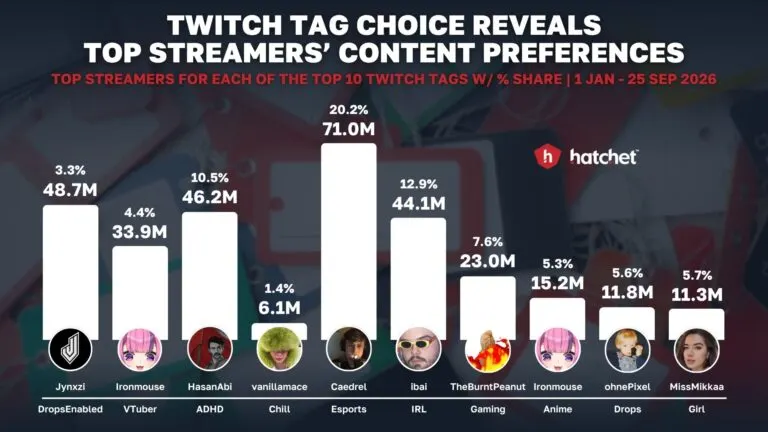
- The three most popular Twitch tags in 2026 so far are DropsEnabled (Twitch Drops), VTuber, and ADHD
- Twitch tags can broadly be split into 5 different categories: Twitch Drops, General Content, Specific Content, Identity Groups, and Vibes
- Their user-generated nature means Twitch tags can reflect growing communities instantly, allowing targeted access to emerging trends
For the Twitch viewer who isn’t already a committed fan of any particular streamer, Twitch tags are their primary method for discovering new content. Twitch’s Search function gives weight to tags on streams (as well as looking at stream titles), but viewers can also specifically find tags alone by heading to Twitch’s Browse page. Perhaps the most powerful use of tags though is their function as hashtags (like on X) that can be clicked on directly to find similar content. In essence, tags are how people find content that matches their specific interests.
In this article, we’re building on our basics of Twitch guide by looking at the most popular tags on Twitch and exploring the trends among them. This includes types of tags, which creators use these tags, and how brands and developers can make use of these tags to get their product in front of a live-streaming audience. We’re going to go one-by-one through each tag type here with the graphics spread throughout.
Five broad categories of tags are used by Twitch streamers:
We do also have some disclaimers about the fallibility of Twitch tag data: Skip to the bottom of this post if you’d like to hear this explanation before jumping into the numbers!
Twitch Drops Twitch Tags
If you’re unfamiliar with Twitch Drops, you can read all about our analysis of them here. But essentially, Twitch Drops are campaigns where viewers tune in to unlock in-game loot. For streamers to participate in a Twitch Drops campaign, they need to apply the relevant tag to their stream. These tags are defined by Twitch and are generally automatically assigned to streams when they’ve turned on their Twitch campaign participation.
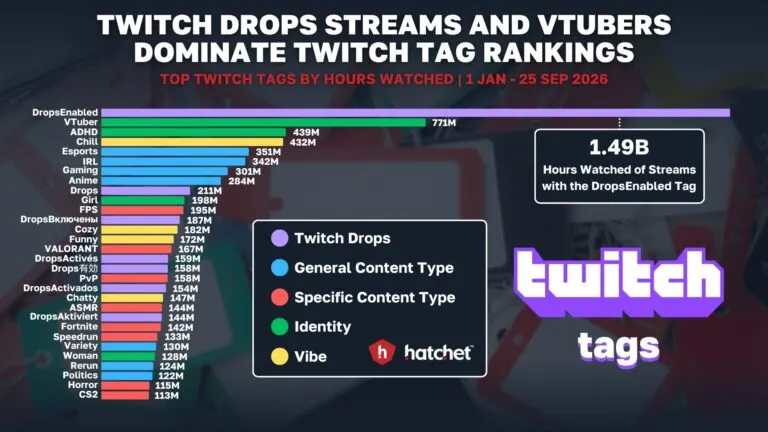
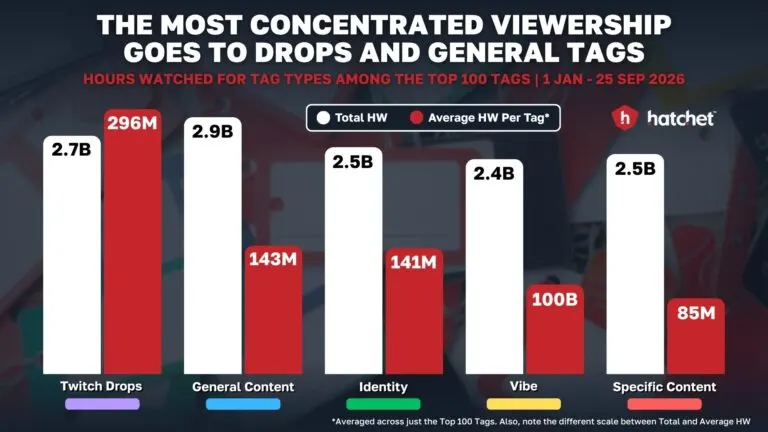
It’s for that reason that DropsEnabled is by far the most watched Twitch tag with 1.49B hours watched. However, this number actually balloons even higher when you add in language-specific, user-generated tags that are sometimes added in addition to the DropsEnabled tag, such as simply “Drops” (211M) and “DropsВключены” (187M). Overall across the top 100 tags, Twitch Drops tags accounted for 2.7B hours watched and had by far the highest average tag viewership at 296M. Jynxzi provided the largest boost to this total with 48.7M hours watched for DropsEnabled streams.
General Content Twitch Tags
General Content Tags signal the kind of action taking place on screen. This can be quite broad, given that Twitch streams cover any number of topics. Naturally, these General Content Tags rank very highly: Esports, IRL, and Gaming tags all pulled in over 300M hours watched each with Esports just edging out the others at 351M. Given that this data runs from January to September, most major leagues have wrapped up now and we’d expect IRL to claw its way back up to the top before 2026 is done.
Compared with other types of tags across the top 100, General Content tags brought in the highest hours watched at 2.9B. But that makes sense given that General Content tags typically overlap with a number of other types of tags (serving as a catch-all bucket) and sharing commonly accepted phrasing/spelling between communities. This is reflected in the diversity of streamers propping up the top General Content tags, including Caedrel (Esports), ibai (IRL), and Ironmouse (Anime).
Specific Content Twitch Tags
Specific Content tags are essentially sub-categories within General Content tags. Specific Content tags provide a far clearer image of the action on display in the stream, which means fewer viewers but also a more niche and dedicated audience. That’s particularly important for targeting ads with specificity instead of just trying to reach the largest possible audience. For example, FPS tops the list at 195M hours watched: Publishers or brands wanting to access that demographic can see exactly which streamers are best to partner with.
Beyond genres and gameplay types though, these tags can get even more specific. Take the Roleplay tag with 98.7M hours watched: Roleplay is popular primarily due to GTA V roleplays, which have whole servers and communities dedicated to collaborating together on Twitch’s most-watched game. The RP tag and specific RP server tags (e.g. NoPixel) are popular for the same reason. Although Specific Content tags may have the lowest average hours watched for tag types among the top 100 at just 85M, those fewer hours come from a more dedicated, defined audience.
Identity Twitch Tags
Identity tags popped up when Twitch removed Communities in 2018, giving people with a shared identity the ability to find like-minded people. Following a streamer generally means seeing some part of yourself in them, relating to their experience: Identity tags make it easier for viewers to find this connection. Although some worry that trolls and hate groups might use Identity tags to harass streamers, the addition has generally been seen as a welcome one.
What’s surprising, perhaps, is that Identity tags are two of the most popular tags on Twitch: VTuber has 771M hours watched, while ADHD has 439M hours watched. VTuber makes sense given that there is no other guaranteed way for a viewer to easily search for VTubers alone, and VTuber is a term that even non-English-speaking streamers will use. ADHD is a bit more complex though: We’re considering ADHD as an Identity tag here since people with ADHD like to watch other neurodivergent streamers (like top ADHD tag streamer HasanAbi). However, some streamers also use ADHD to refer to the type of content they’re producing, including highly varied content or competitive challenges requiring multitasking.
Vibe Twitch Tags
Lastly, we have Vibe Tags: Tags that give the viewer an idea of the atmosphere they can expect when tuning in. With games covering so many genres, it’s easy to see how a hardcore, “sweaty” gaming stream might not appeal to someone looking for a more relaxed, laidback atmosphere. Three of the most common Vibe Tags are all fairly similar: Chill, Chatty, and Cozy. All three imply an emphasis on casual content that is less about the game and more about the comforting atmosphere of the streamer presenting the game. Additionally, these tags offer a more concrete way of filtering out the ever-popular esports and competitive content on Twitch.
What’s interesting with Vibe tags is that, unlike the other tag types, there isn’t a handful of mega-popular streamers driving this viewership. Take Chill for example: The top creator here, vanillamace, generated just 6.1M hours watched in this timespan, which is only 1.4% of the massive 432M hours watched seen under the entire tag. These Vibe tags thus offer the best targets for brands hoping to reach a more diverse audience, aligning the streamers’ vibes with their own image.
The best tagging strategy involves combining all of these tags together, which streamers do naturally as they define the content type, identity, and vibe of their stream. But oddly, Twitch doesn’t allow for native filtering of streams by multiple tags simultaneously. Thankfully, you can find tools online that will do this for you, such as this one from software engineer crunchprank.
However, getting the most out of Twitch tags requires expert knowledge of the live-streaming landscape to understand which tags target which demographics. An indie game dev with a casual crafting game has very different tagging needs to, say, an energy drink company. Understanding tags is the key to finding your audience on Twitch.
If you’re looking to access even more niche tags, dive into our app for free and access 4,000+ tags right now:
Access More Tags Data for Free
To get the latest insights impacting streaming and socials, follow Hatchet and receive exclusive newsletter-only content:
Subscribe to the Hatchet Newsletter
Some Notes on Twitch Tag Data…
Tag data isn’t foolproof for a number of reasons that bear understanding for this analysis. For starters, Twitch has three types of tags: Automatic tags, category tags, and custom tags. Automatic tags include language tags to denote the streamer’s spoken language, and category tags can be applied to game genres or specific game titles. For the purpose of analysis here, we’re looking exclusively at custom tags.
Additionally, custom tags don’t automatically convert between languages. An English streamer might add the tag “autism” to show their stream is autism-friendly. But a French speaker with the same intention will add the tag “autisme”. These tags therefore aren’t counted together. For this reason, tags that cross language barriers (“anime”) or are internet-friendly acronyms (“IRL”) tend to rank more highly.
Finally, streamers often interpret tags in their own manner. This can be due to many reasons: They may be “blanket tagging” their content (when creators use the same tag on all of their streams even when their content for the day is different). Alternatively, they may use known popular tags to boost their viewership (such as Caedrel or xQc using the “VTuber” tag). Or, as one last example, they might use an FPS tag for a GTA V stream, considering all shooters to be FPS titles. Due to this subjectivity in tagging, some tags become more popular than others.